March 23, 2009

instrument

The body will be turned by the power of the spiritual consciousness into a true and fit and perfectly responsive instrument of the Spirit.

~ Sri Aurobindo

Posted by Picasa

March 3, 2009

nothing dehumanizing about this

German twenty-somethings prefer Internet to partner
Reuters, March 2, 2009

HANOVER - German twenty-somethings would ditch their spouses and do without a car in a heartbeat if they had to choose between having them or Internet access or a mobile phone, according to an industry study.

In a survey by German broadband association Bitkom around 84 percent of respondents aged 19-29 said they would rather do without their current partner or an automobile than forego their connection to the Web.

Living without a mobile phone was also unthinkable for 97 percent of those questioned in that age range.

Nevertheless, Bitkom president August-Wilhelm Scheer said on Monday in Hanover that did not mean that "the Web is an anonymous medium that leads to social indifference." . . .

~ Full story here

February 27, 2009

true Self

Love your true Self,
Which is naturally happy
And peaceful and bright!

Awaken to your own nature,
And all delusion melts like a dream.


-Ashtavakra Gita 18:1


February 19, 2009

carbon sink

Forests absorb 20 percent of fossil fuel emissions: study
By Michael Kahn, Reuters, February 18, 2009

LONDON - Tropical trees have grown bigger over the past 40 years and now absorb 20 percent of fossil fuel emissions from the atmosphere, highlighting the need to preserve threatened forests, British researchers said Wednesday.

Using data collected from nearly 250,000 trees in the world's tropical forests over the past 40 years, their study found that tropical forests across the world remove 4.8 billion metric tons of carbon dioxide emissions each year.


"To get an idea of the value of the sink, the removal of nearly 5 billion tons of carbon dioxide from the atmosphere by intact tropical forests, based on realistic prices for a ton of carbon, should be valued at around 13 billion pounds per year," said Lee White, Gabon's chief climate change scientist, who co-led the study, said in a statement.

The researchers do not know exactly why trees are getting bigger and mopping up more carbon but they suspect that extra carbon dioxide in the atmosphere may be acting like a fertilizer. . . .

~ Full story here

an end to the Roaring 2000s

The Shopper of Tomorrow: Trading Down
February 18, 2009, in Knowledge@Wharton, The Wharton School

Attention Shoppers: We no longer have the following items -- "a sense of entitlement," "conspicuous consumption" and "a golden period of luxury." At least that is the word from Wharton faculty and other experts who point to a new logic that is defining not just what U.S. consumers buy, but how they view the shopping experience.

While shoppers typically pull back during the downward phase of any economic cycle, the severity and uncertainty of today's crisis is likely to have longer-lasting effects on their attitudes than most slumps, these experts note. Consumers, they suggest, will eventually start spending again, but without the vigor enabled by easy credit in the Roaring 2000s.

"The Great Depression certainly changed consumer behavior and attitudes for a generation," says Wharton marketing professor Wesley Hutchinson. "It's not obvious that we will have that psychological scar, but there is precedent for a very large shift."

Over the next 18 months, Hutchinson predicts, consumers will learn to become more frugal and are likely to carry those skills over once the economy recovers. "At some level, everybody has now been schooled about financial markets and overextending one's credit -- something American consumers have been notoriously bad at. We had a habit of not paying a lot of attention to the cost of using borrowed money."

Wharton marketing professor Stephen Hoch sees consumers as embracing a new logic. "Until recently, there has been a theme of entitlement that people really latched onto," he says. It was built on the belief that consumers worked hard and were entitled to splurge on rewards to compensate for the time and energy devoted to making money. Luxury goods marketers promoted the "entitlement" theme heavily, although they have now backed away almost entirely from this pitch.

Consumers who had learned to trade up when times were flush are now learning to trade down, Hoch adds. They realize they were wasting money on higher-priced goods and services when less expensive alternatives were available with little real trade-off in quality or satisfaction. Indeed, many consumers regret what they used to spend; they are finding a new sense of well-being in becoming more discerning shoppers. "There will be more of a premium placed on seeking value," Hoch says. "People will realize that's being smart." . . .

~ Full article here

February 16, 2009

how to make singers lazy

Auto-Tune: Why Pop Music Sounds Perfect
By Josh Tyrangiel, TIME, February 5, 2009

If you haven't been listening to pop radio in the past few months, you've missed the rise of two seemingly opposing trends. In a medium in which mediocre singing has never been a bar to entry, a lot of pop vocals suddenly sound great. Better than great: note- and pitch-perfect, as if there's been an unspoken tightening of standards at record labels or an evolutionary leap in the development of vocal cords. At the other extreme are a few hip-hop singers who also hit their notes but with a precision so exaggerated that on first listen, their songs sound comically artificial, like a chorus of '50s robots singing Motown.

The force behind both trends is an ingenious plug-in called Auto-Tune, a downloadable studio trick that can take a vocal and instantly nudge it onto the proper note or move it to the correct pitch. It's like Photoshop for the human voice. Auto-Tune doesn't make it possible for just anyone to sing like a pro, but used as its creator intended, it can transform a wavering performance into something technically flawless. "Right now, if you listen to pop, everything is in perfect pitch, perfect time and perfect tune," says producer Rick Rubin. "That's how ubiquitous Auto-Tune is."

Auto-Tune's inventor is a man named Andy Hildebrand, who worked for years interpreting seismic data for the oil industry. Using a mathematical formula called autocorrelation, Hildebrand would send sound waves into the ground and record their reflections, providing an accurate map of potential drill sites. It's a technique that saves oil companies lots of money and allowed Hildebrand to retire at 40. He was debating the next chapter of his life at a dinner party when a guest challenged him to invent a box that would allow her to sing in tune. After he tinkered with autocorrelation for a few months, Auto-Tune was born in late 1996.

Almost immediately, studio engineers adopted it as a trade secret to fix flubbed notes, saving them the expense and hassle of having to redo sessions. The first time common ears heard Auto-Tune was on the immensely irritating 1998 Cher hit "Believe." In the first verse, when Cher sings "I can't break through" as though she's standing behind an electric fan, that's Auto-Tune--but it's not the way Hildebrand meant it to be used. The program's retune speed, which adjusts the singer's voice, can be set from zero to 400. "If you set it to 10, that means that the output pitch will get halfway to the target pitch in 10 milliseconds," says Hildebrand. "But if you let that parameter go to zero, it finds the nearest note and changes the output pitch instantaneously"--eliminating the natural transition between notes and making the singer sound jumpy and automated. "I never figured anyone in their right mind would want to do that," he says. . . .

~ Complete story here
Posted by Picasa

February 11, 2009

"justice" in American sports

Phelps gets suspended, A-Rod gets ... nothing
By Daniel Trotta, Reuters, February 11, 2009

The punishments of swimmer Michael Phelps and baseball star Alex Rodriguez don't fit their relative crimes, experts said, raising questions about how Americans treat their sports heroes when they fall from grace.

Phelps partied with marijuana, a performance-detracting drug, and was suspended from swimming. Rodriguez took banned performance-enhancing drugs for three years and suffered no penalty but an uncomfortable television interview.

The American swimmer Phelps, 23, won a record eight gold medals at the Beijing Games last summer but lost an endorsement deal with U.S. food giant Kellogg Co after a British newspaper published a picture of the Olympic champion apparently smoking marijuana.

USA Swimming then suspended him for three months.

Rodriguez, 33, the highest paid player in baseball, admitted to ESPN television on Monday that he took a banned substance from 2001 to 2003 after Sports Illustrated reported he tested positive for testosterone and the anabolic steroid Primobolan in 2003.

He escapes sanctions from Major League baseball because it did not punish players at that time for using steroids.

"We should leave Michael Phelps alone. He's a kid. So he made a mistake. He owned up to it right away -- as opposed to A-Rod, whose been lying about it for a number of years," said Deborah Cohn, professor of marketing at New York's Touro College.

So far other sponsors have stood by Phelps, including Speedo swimwear, Omega watches, Visa Inc, Subway sandwiches and Hilton Hotels Corp. . . .

~ Full story here

February 10, 2009

shrinking winter

Study: Birds shifting north; global warming cited
By Dina Cappiello, Associated Press, February 10, 2009

When it comes to global warming, the canary in the coal mine isn't a canary at all. It's a purple finch.

As the temperature across the U.S. has gotten warmer, the purple finch has been spending its winters more than 400 miles farther north than it used to.

And it's not alone.

An Audubon Society study has found that more than half of 305 birds species in North America, a hodgepodge that includes robins, gulls, chickadees and owls, are spending the winter about 35 miles farther north than they did 40 years ago.

The purple finch was the biggest northward mover. Its wintering grounds are now more along the latitude of Milwaukee, Wis., instead of Springfield, Mo.

Bird ranges can expand and shift for many reasons, among them urban sprawl, deforestation and the supplemental diet provided by backyard feeders. But researchers say the only explanation for why so many birds over such a broad area are wintering in more northern locales is global warming.

Over the 40 years covered by the study, the average January temperature in the United States climbed by about 5 degrees Fahrenheit. That warming was most pronounced in northern states, which have already recorded an influx of more southern species and could see some northern species retreat into Canada as ranges shift. . . .

~ Full story here

fire

Suffering chastens us and makes us remember. We are like the child who tries to pick up fire and is unlikely to do it again, once she has seen the consequences. With material things, seeing is easy; but when it comes to picking up the fires of greed, aversion, and delusion, most of us aren’t even aware we’re holding fires at all. On the contrary, we misguidedly believe them to be lovable and desirable, and so we are never chastened. We never learn our lesson.

~ Buddhadhasa Bhikku, "Heartwood of the Bodhi Tree"

January 23, 2009

mors arboris


Study Ties Tree Deaths To Change in Climate
By Juliet Eilperin, Washington Post, January 23, 2009

The death rates of trees in Western U.S. forests have doubled over the past two to three decades, according to a new study spearheaded by the U.S. Geological Survey, driven in large part by higher temperatures and water scarcity linked to climate change.

The findings, being published today in the online journal Science, examined changes in 76 long-term forest plots in three broad regions across the West, and found similar shifts regardless of the areas' elevations, fire histories, dominant species and tree sizes. It is the largest research project ever done on old-growth forests in North America.

Nathan L. Stephenson, one of the lead authors, said summers are getting longer and hotter in the West, subjecting trees to greater stress from droughts and attacks by insect infestations, factors that contribute to tree die-offs.

"It's very likely that mortality rates will continue to rise," said Stephenson, a scientist at the Geological Survey's Western Ecological Research Center, adding that the death of older trees is rapidly exceeding the growth of new ones, akin to a town where the deaths of old people are outpacing the number of babies being born. "If you saw that going on in your home town, you'd be concerned." . . .

~ Full story here
Posted by Picasa

January 14, 2009

more news from the ovarian lottery

In High-Stakes Stock Trading, Finger Length Matters
Study finds testosterone exposure in womb creates long ring finger, financial success
By Alan Mozes, HealthDay Reporter, MSN.com/HealthDay News, January 12, 2009

For all those whose ring finger far outstretches their index finger, British researchers have pinpointed the perfect job: high-volume stock trader.

According to a new study, having a relatively long ring finger augurs well for success in those high-stress financial arenas where fast thinking, good reflexes and good old-fashioned guts matter most. A lengthy fourth digit, the authors note, indicates greater exposure to testosterone in the womb, which in turn gives what they call "high-frequency" traders a biological leg up by encouraging the development of the right mix of mental attitude and physical skills for making money in a cutthroat business.

The finding is reported in this week's issue of the Proceedings of the National Academy of Sciences. . . .

The team noted that a reliable marker for high prenatal testosterone exposure is having a fourth finger (ring finger) that is longer than the second finger (index finger), a ratio previously used to predict improved performance in a range of competitive sports. The authors then used this finger size indicator -- known as 2D:4D -- to stack up each trader's financial success with his testosterone exposure while in the womb.

After accounting for both trader age and years of job experience, Coates and his associates concluded that having a relatively long ring finger (meaning more testosterone exposure in the womb) appeared to be equal to experience as a harbinger of greater financial success in high-frequency trading.

They stressed that in other financial arenas, the testosterone effect might not be as central. But in the specific world of high-frequency trading, having a lengthy ring finger relative to the index finger definitely appeared to translate into both higher long-term profitability and a longer period of time in which the person remained in the high-frequency trading field. . . .

~Full story here

January 13, 2009

Georgey Bushy Agonistes

With a nod toward Gary Wills -- Surprise, surprise. It turns out, upon his "exit strategy," that George Bush is even more unbearable than we could have realized.


Analysis: With odd news conference, Bush offers extraordinary glimpse into presidency

By Ted Anthony, Associated Press National Writer, January 13, 2009

Picture Lincoln, in the throes of the Civil War, suddenly mocking his critics in a nyah-nyah voice. Imagine Theodore Roosevelt, leaving office, lamenting out loud about how hated he was by Standard Oil. Summon an image of FDR cracking wise about his wheelchair and grousing about the nasty things Hitler was saying about him.

Now consider George W. Bush on Monday. He bobbed and weaved and smiled wistfully, quipped about giving up drinking, deployed a mock European accent to kid a reporter, vowed to make his wife coffee. At the same time, he warned about terrorism, bristled at comments that the federal response to Hurricane Katrina was slow and said finding no weapons of mass destruction in Iraq — the rationale for a six-year war — was "a significant disappointment."

"You never escape the presidency," says Bush, who is about to. But before he did, the guy who is the most powerful leader on the planet for one more week had some things to say in what he called "the ultimate exit interview."

The session, televised live, was offered up as a valedictory news conference. But it also proved an extraordinary glimpse behind the psychic curtain and an illuminating window into what we want — and may not want — out of the modern presidency.

Bush was at turns erratic and eloquent, nostalgic and melancholy, gracious and cantankerous, regular guy-ish and resignation-era Nixonian. It all felt strangely intimate and, occasionally, uncomfortable in the manner of seeing a plumber wearing jeans that ride too low.

"He was like a second-semester senior — the grades don't matter anymore," said John Baick, a historian at Western New England College who studies the presidency.

Americans are forever insisting they want a regular Joe in the Oval Office, someone they could go out and grab a beer with. Could it be, though, that in this post-Monicagate era of the celebrity full monty, there are actually some presidential ruminations we can do without? Was George W. Bush, of all people, too intimate on Monday? . . .

~Full article here

Posted by Picasa

bottomed-out boomers

Boomers Caught in Squeeze Play
Why this group's changing fortunes could mean a slowdown in consumption for years to come
By Noreen O'Leary, Adweek, January 12, 2009

American consumers have no recollection of life in the Great Depression. Not only are most simply too young to remember it, but for the last quarter century they've lived without extended economic hardship, becoming ever more acquisitive in a world of instant gratification and easy credit. No one knows how long or severe the current downturn will be.

The circumstances of this recession are unprecedented in the history of modern consumerism: For a generation that has substituted rising home equity and stock prices for personal savings, the current economic meltdown -- with the value of the Dow Jones Industrial Index plunging 40 percent from its peak and $4 trillion lost in home equity -- has been psychologically wrenching after a quarter century of unquestioned prosperity.

Factor in the loss of confidence in financial institutions and an investing world where even the very rich can be wiped out through Ponzi schemes and you have a group of shell-shocked consumers who are reconsidering long-held spending habits.

Much has been made about the everyday stuff of thrifty consumerism -- coupon clipping, fewer restaurant meals, brown-bagging it to work, staying close to home for vacations. But those thumbnail sketches of a contracting economy miss the big picture: The fears among baby boomers, who account for more than half of U.S. spending and who traditionally have grown more affluent with age.

Eric Almquist, a Bain & Co. partner, points to the number of retirement-age individuals who are becoming more conservative with money. "One of the unique things in the Western world now is that you have a huge group of pre-retirement baby boomers, a huge number of people who are asking, 'Can I live off my savings and social security for the rest of my life?'" observes Almquist. "This creates the potential to switch behaviors. They'll watch pennies more closely, be more careful with credit, avoid losses and be more risk adverse, preserve the status quo, rather than gain gains."

Already there are signs of that change. In one of the most dramatic reversals in post-World War II history, Americans -- who in recent years have had negative savings rate -- are expected to flip those patterns, with Goldman Sachs now saying the U.S. savings rate could be as high as 6 percent to 10 percent this year. . . .


~ Full story here

January 5, 2009

the modern Nero

In its enitrety, here is an essay by Bob Herbert that sums up the complete and total disaster of the Bush Administration and the damage it has done to the United States.


Add Up the Damage
By Bob Herbert, Op-Ed Columnist, The New York Times, December 30, 2008

Does anyone know where George W. Bush is?

You don’t hear much from him anymore. The last image most of us remember is of the president ducking a pair of size 10s that were hurled at him in Baghdad.

We’re still at war in Iraq and Afghanistan. Israel is thrashing the Palestinians in Gaza. And the U.S. economy is about as vibrant as the 0-16 Detroit Lions.

But hardly a peep have we heard from George, the 43rd.

When Mr. Bush officially takes his leave in three weeks (in reality, he checked out long ago), most Americans will be content to sigh good riddance. I disagree. I don’t think he should be allowed to slip quietly out of town. There should be a great hue and cry — a loud, collective angry howl, demonstrations with signs and bullhorns and fiery speeches — over the damage he’s done to this country.

This is the man who gave us the war in Iraq and Guantánamo and torture and rendition; who turned the Clinton economy and the budget surplus into fool’s gold; who dithered while New Orleans drowned; who trampled our civil liberties at home and ruined our reputation abroad; who let Dick Cheney run hog wild and thought Brownie was doing a heckuva job.

The Bush administration specialized in deceit. How else could you get the public (and a feckless Congress) to go along with an invasion of Iraq as an absolutely essential response to the Sept. 11 attacks, when Iraq had had nothing to do with the Sept. 11 attacks?

Exploiting the public’s understandable fears, Mr. Bush made it sound as if Iraq was about to nuke us: “We cannot wait,” he said, “for the final proof — the smoking gun that could come in the form of a mushroom cloud.”

He then set the blaze that has continued to rage for nearly six years, consuming more than 4,000 American lives and hundreds of thousands of Iraqis. (A car bomb over the weekend killed two dozen more Iraqis, many of them religious pilgrims.) The financial cost to the U.S. will eventually reach $3 trillion or more, according to the Nobel laureate economist Joseph Stiglitz.
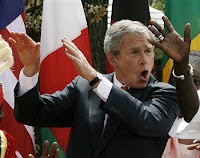
A year into the war Mr. Bush was cracking jokes about it at the annual dinner of the Radio and Television Correspondents Association. He displayed a series of photos that showed him searching the Oval Office, peering behind curtains and looking under the furniture. A mock caption had Mr. Bush saying: “Those weapons of mass destruction have got to be somewhere.”

And then there’s the Bush economy, another disaster, a trapdoor through which middle-class Americans can plunge toward the bracing experiences normally reserved for the poor and the destitute.

Mr. Bush traveled the country in the early days of his presidency, promoting his tax cut plans as hugely beneficial to small-business people and families of modest means. This was more deceit. The tax cuts would go overwhelmingly to the very rich.

The president would give the wealthy and the powerful virtually everything they wanted. He would throw sand into the regulatory apparatus and help foster the most extreme income disparities since the years leading up to the Great Depression. Once again he was lighting a fire. This time the flames would engulf the economy and, as with Iraq, bring catastrophe.

If the U.S. were a product line, it would be seen now as deeply damaged goods, subject to recall.

There seemed to be no end to Mr. Bush’s talent for destruction. He tried to hand the piggy bank known as Social Security over to the marauders of the financial sector, but saner heads prevailed.

In New Orleans, the president failed to intervene swiftly and decisively to aid the tens of thousands of poor people who were very publicly suffering and, in many cases, dying. He then compounded this colossal failure of leadership by traveling to New Orleans and promising, in a dramatic, floodlit appearance, to spare no effort in rebuilding the flood-torn region and the wrecked lives of the victims.

He went further, vowing to confront the issue of poverty in America “with bold action.”

It was all nonsense, of course. He did nothing of the kind.

The catalog of his transgressions against the nation’s interests — sins of commission and omission — would keep Mr. Bush in a confessional for the rest of his life. Don’t hold your breath. He’s hardly the contrite sort.

He told ABC’s Charlie Gibson: “I don’t spend a lot of time really worrying about short-term history. I guess I don’t worry about long-term history, either, since I’m not going to be around to read it.”

The president chuckled, thinking — as he did when he made his jokes about the missing weapons of mass destruction — that there was something funny going on.
~ The article appears here / Copyright The New York Times 2008

golden birds

The ego and the Self dwell as intimate friends in the same body, like two golden birds perched in the same tree.

The ego eats the sweet and sour fruits of the tree, while the Self looks on detached.

For as long as you identify with the ego, you will feel joy and sorrow.


~ Mundaka Upanishad


December 24, 2008

on earth

Live in rooms full of light.
-- Aulus Cornelius Celsus (ca. 25 BC—ca. 50)


December 19, 2008

storm

Knowing yourself as That
In which the worlds rise and fall
Like waves in the ocean,
Why do you run about so wretchedly?


~ Ashtavakra Gita 3:3

From "The Heart of Awareness: A Translation of the Ashtavakra Gita," by Thomas Byrom


December 16, 2008

an "enterprising" idea

Paying down the deficit with whizzing shoes
By Nicholas Kristof, The New York Times, December 15, 2008

A Saudi reportedly has offered $10 million for just one of the shoes thrown at President Bush in Iraq. That got me thinking. The journalist who threw the shoes no longer possesses them, of course, but hopefully some member of the White House staff picked them up and will do a deal with the Saudi buyer. The second one could be put on Ebay to defray the White House travel costs.

But that got me thinking. The Times article about the Saudi offer says that the shoe-thrower is a hero around Iraq, and indeed in much of the Arab world. That suggests that the resale market for shoes thrown at Mr. Bush is fairly deep. And in this difficult economic environment, can we as a nation overlook any way of raising money?

Couldn’t we trot out Mr. Bush before a series of, er, unfriendly audiences, with a White house aide then designated to collect the shoes and auction them off? (To protect Mr. Bush, we could insist that attendees wear only slippers, but in any case he seems to have excellent reflexes and is a pretty good sport.) My own research suggests that a three-week presidential tour of the Islamic world, Latin America and Western Europe would generate a considerable number of flying shoes. Even if there are diminishing returns and we can sell them for an average of only $3 million each, that could bring hundreds of millions of dollars into the Treasury. If a Saudi will pay $10 million for a single shoe that missed the president, consider the income-earning potential of a pair of slippers that actually grazed a presidential ear, perhaps autographed by him as well? Given that a lame-duck president doesn’t have much else to do, Mr. Bush might as well spend his final weeks raising money to pay for a fiscal stimulus, and the United States might capitalize on his global unpopularity.

December 3, 2008

312 million years

Ancient insect imprint found in Massachusetts
By Gene Emery, Reuters, December 3, 2008

U.S. researchers say they have discovered what appears to be the oldest imprint of a prehistoric insect, made while the dragonfly-like creature was still alive.

The imprint found at a rocky outcrop near a large shopping center in North Attleboro, Massachusetts, is believed to have been made by an insect about three inches long as it stood on mud some 312 million years ago.

"It's not a dragonfly but picture a dragonfly-like body. We're looking at something related, maybe a mayfly. They have the same body plan," said the discoverer, Richard Knecht, a geology student at Tufts University in Massachusetts.

The fossilized remains of a wing that may have belonged to the same species were uncovered two weeks ago. . . .

~ Full story here

November 30, 2008

awakened

An act of meditation is actually an act of faith -- of faith in your spirit, in your own potential. Faith is the basis of meditation. Not of faith in something outside you -- a metaphysical buddha, an unattainable ideal, or someone else's words. The faith is in yourself, in your own "buddha-nature." You too can be a buddha, an awakened being that lives and responds in a wise, creative, and compassionate way.

~ Martine Batchelor, "Meditation for Life"

Posted by Picasa