February 10, 2009

shrinking winter

Study: Birds shifting north; global warming cited
By Dina Cappiello, Associated Press, February 10, 2009

When it comes to global warming, the canary in the coal mine isn't a canary at all. It's a purple finch.

As the temperature across the U.S. has gotten warmer, the purple finch has been spending its winters more than 400 miles farther north than it used to.

And it's not alone.

An Audubon Society study has found that more than half of 305 birds species in North America, a hodgepodge that includes robins, gulls, chickadees and owls, are spending the winter about 35 miles farther north than they did 40 years ago.

The purple finch was the biggest northward mover. Its wintering grounds are now more along the latitude of Milwaukee, Wis., instead of Springfield, Mo.

Bird ranges can expand and shift for many reasons, among them urban sprawl, deforestation and the supplemental diet provided by backyard feeders. But researchers say the only explanation for why so many birds over such a broad area are wintering in more northern locales is global warming.

Over the 40 years covered by the study, the average January temperature in the United States climbed by about 5 degrees Fahrenheit. That warming was most pronounced in northern states, which have already recorded an influx of more southern species and could see some northern species retreat into Canada as ranges shift. . . .

~ Full story here

fire

Suffering chastens us and makes us remember. We are like the child who tries to pick up fire and is unlikely to do it again, once she has seen the consequences. With material things, seeing is easy; but when it comes to picking up the fires of greed, aversion, and delusion, most of us aren’t even aware we’re holding fires at all. On the contrary, we misguidedly believe them to be lovable and desirable, and so we are never chastened. We never learn our lesson.

~ Buddhadhasa Bhikku, "Heartwood of the Bodhi Tree"

January 23, 2009

mors arboris


Study Ties Tree Deaths To Change in Climate
By Juliet Eilperin, Washington Post, January 23, 2009

The death rates of trees in Western U.S. forests have doubled over the past two to three decades, according to a new study spearheaded by the U.S. Geological Survey, driven in large part by higher temperatures and water scarcity linked to climate change.

The findings, being published today in the online journal Science, examined changes in 76 long-term forest plots in three broad regions across the West, and found similar shifts regardless of the areas' elevations, fire histories, dominant species and tree sizes. It is the largest research project ever done on old-growth forests in North America.

Nathan L. Stephenson, one of the lead authors, said summers are getting longer and hotter in the West, subjecting trees to greater stress from droughts and attacks by insect infestations, factors that contribute to tree die-offs.

"It's very likely that mortality rates will continue to rise," said Stephenson, a scientist at the Geological Survey's Western Ecological Research Center, adding that the death of older trees is rapidly exceeding the growth of new ones, akin to a town where the deaths of old people are outpacing the number of babies being born. "If you saw that going on in your home town, you'd be concerned." . . .

~ Full story here
Posted by Picasa

January 14, 2009

more news from the ovarian lottery

In High-Stakes Stock Trading, Finger Length Matters
Study finds testosterone exposure in womb creates long ring finger, financial success
By Alan Mozes, HealthDay Reporter, MSN.com/HealthDay News, January 12, 2009

For all those whose ring finger far outstretches their index finger, British researchers have pinpointed the perfect job: high-volume stock trader.

According to a new study, having a relatively long ring finger augurs well for success in those high-stress financial arenas where fast thinking, good reflexes and good old-fashioned guts matter most. A lengthy fourth digit, the authors note, indicates greater exposure to testosterone in the womb, which in turn gives what they call "high-frequency" traders a biological leg up by encouraging the development of the right mix of mental attitude and physical skills for making money in a cutthroat business.

The finding is reported in this week's issue of the Proceedings of the National Academy of Sciences. . . .

The team noted that a reliable marker for high prenatal testosterone exposure is having a fourth finger (ring finger) that is longer than the second finger (index finger), a ratio previously used to predict improved performance in a range of competitive sports. The authors then used this finger size indicator -- known as 2D:4D -- to stack up each trader's financial success with his testosterone exposure while in the womb.

After accounting for both trader age and years of job experience, Coates and his associates concluded that having a relatively long ring finger (meaning more testosterone exposure in the womb) appeared to be equal to experience as a harbinger of greater financial success in high-frequency trading.

They stressed that in other financial arenas, the testosterone effect might not be as central. But in the specific world of high-frequency trading, having a lengthy ring finger relative to the index finger definitely appeared to translate into both higher long-term profitability and a longer period of time in which the person remained in the high-frequency trading field. . . .

~Full story here

January 13, 2009

Georgey Bushy Agonistes

With a nod toward Gary Wills -- Surprise, surprise. It turns out, upon his "exit strategy," that George Bush is even more unbearable than we could have realized.


Analysis: With odd news conference, Bush offers extraordinary glimpse into presidency

By Ted Anthony, Associated Press National Writer, January 13, 2009

Picture Lincoln, in the throes of the Civil War, suddenly mocking his critics in a nyah-nyah voice. Imagine Theodore Roosevelt, leaving office, lamenting out loud about how hated he was by Standard Oil. Summon an image of FDR cracking wise about his wheelchair and grousing about the nasty things Hitler was saying about him.

Now consider George W. Bush on Monday. He bobbed and weaved and smiled wistfully, quipped about giving up drinking, deployed a mock European accent to kid a reporter, vowed to make his wife coffee. At the same time, he warned about terrorism, bristled at comments that the federal response to Hurricane Katrina was slow and said finding no weapons of mass destruction in Iraq — the rationale for a six-year war — was "a significant disappointment."

"You never escape the presidency," says Bush, who is about to. But before he did, the guy who is the most powerful leader on the planet for one more week had some things to say in what he called "the ultimate exit interview."

The session, televised live, was offered up as a valedictory news conference. But it also proved an extraordinary glimpse behind the psychic curtain and an illuminating window into what we want — and may not want — out of the modern presidency.

Bush was at turns erratic and eloquent, nostalgic and melancholy, gracious and cantankerous, regular guy-ish and resignation-era Nixonian. It all felt strangely intimate and, occasionally, uncomfortable in the manner of seeing a plumber wearing jeans that ride too low.

"He was like a second-semester senior — the grades don't matter anymore," said John Baick, a historian at Western New England College who studies the presidency.

Americans are forever insisting they want a regular Joe in the Oval Office, someone they could go out and grab a beer with. Could it be, though, that in this post-Monicagate era of the celebrity full monty, there are actually some presidential ruminations we can do without? Was George W. Bush, of all people, too intimate on Monday? . . .

~Full article here

Posted by Picasa

bottomed-out boomers

Boomers Caught in Squeeze Play
Why this group's changing fortunes could mean a slowdown in consumption for years to come
By Noreen O'Leary, Adweek, January 12, 2009

American consumers have no recollection of life in the Great Depression. Not only are most simply too young to remember it, but for the last quarter century they've lived without extended economic hardship, becoming ever more acquisitive in a world of instant gratification and easy credit. No one knows how long or severe the current downturn will be.

The circumstances of this recession are unprecedented in the history of modern consumerism: For a generation that has substituted rising home equity and stock prices for personal savings, the current economic meltdown -- with the value of the Dow Jones Industrial Index plunging 40 percent from its peak and $4 trillion lost in home equity -- has been psychologically wrenching after a quarter century of unquestioned prosperity.

Factor in the loss of confidence in financial institutions and an investing world where even the very rich can be wiped out through Ponzi schemes and you have a group of shell-shocked consumers who are reconsidering long-held spending habits.

Much has been made about the everyday stuff of thrifty consumerism -- coupon clipping, fewer restaurant meals, brown-bagging it to work, staying close to home for vacations. But those thumbnail sketches of a contracting economy miss the big picture: The fears among baby boomers, who account for more than half of U.S. spending and who traditionally have grown more affluent with age.

Eric Almquist, a Bain & Co. partner, points to the number of retirement-age individuals who are becoming more conservative with money. "One of the unique things in the Western world now is that you have a huge group of pre-retirement baby boomers, a huge number of people who are asking, 'Can I live off my savings and social security for the rest of my life?'" observes Almquist. "This creates the potential to switch behaviors. They'll watch pennies more closely, be more careful with credit, avoid losses and be more risk adverse, preserve the status quo, rather than gain gains."

Already there are signs of that change. In one of the most dramatic reversals in post-World War II history, Americans -- who in recent years have had negative savings rate -- are expected to flip those patterns, with Goldman Sachs now saying the U.S. savings rate could be as high as 6 percent to 10 percent this year. . . .


~ Full story here

January 5, 2009

the modern Nero

In its enitrety, here is an essay by Bob Herbert that sums up the complete and total disaster of the Bush Administration and the damage it has done to the United States.


Add Up the Damage
By Bob Herbert, Op-Ed Columnist, The New York Times, December 30, 2008

Does anyone know where George W. Bush is?

You don’t hear much from him anymore. The last image most of us remember is of the president ducking a pair of size 10s that were hurled at him in Baghdad.

We’re still at war in Iraq and Afghanistan. Israel is thrashing the Palestinians in Gaza. And the U.S. economy is about as vibrant as the 0-16 Detroit Lions.

But hardly a peep have we heard from George, the 43rd.

When Mr. Bush officially takes his leave in three weeks (in reality, he checked out long ago), most Americans will be content to sigh good riddance. I disagree. I don’t think he should be allowed to slip quietly out of town. There should be a great hue and cry — a loud, collective angry howl, demonstrations with signs and bullhorns and fiery speeches — over the damage he’s done to this country.

This is the man who gave us the war in Iraq and Guantánamo and torture and rendition; who turned the Clinton economy and the budget surplus into fool’s gold; who dithered while New Orleans drowned; who trampled our civil liberties at home and ruined our reputation abroad; who let Dick Cheney run hog wild and thought Brownie was doing a heckuva job.

The Bush administration specialized in deceit. How else could you get the public (and a feckless Congress) to go along with an invasion of Iraq as an absolutely essential response to the Sept. 11 attacks, when Iraq had had nothing to do with the Sept. 11 attacks?

Exploiting the public’s understandable fears, Mr. Bush made it sound as if Iraq was about to nuke us: “We cannot wait,” he said, “for the final proof — the smoking gun that could come in the form of a mushroom cloud.”

He then set the blaze that has continued to rage for nearly six years, consuming more than 4,000 American lives and hundreds of thousands of Iraqis. (A car bomb over the weekend killed two dozen more Iraqis, many of them religious pilgrims.) The financial cost to the U.S. will eventually reach $3 trillion or more, according to the Nobel laureate economist Joseph Stiglitz.
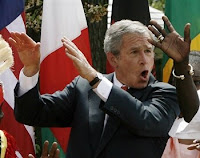
A year into the war Mr. Bush was cracking jokes about it at the annual dinner of the Radio and Television Correspondents Association. He displayed a series of photos that showed him searching the Oval Office, peering behind curtains and looking under the furniture. A mock caption had Mr. Bush saying: “Those weapons of mass destruction have got to be somewhere.”

And then there’s the Bush economy, another disaster, a trapdoor through which middle-class Americans can plunge toward the bracing experiences normally reserved for the poor and the destitute.

Mr. Bush traveled the country in the early days of his presidency, promoting his tax cut plans as hugely beneficial to small-business people and families of modest means. This was more deceit. The tax cuts would go overwhelmingly to the very rich.

The president would give the wealthy and the powerful virtually everything they wanted. He would throw sand into the regulatory apparatus and help foster the most extreme income disparities since the years leading up to the Great Depression. Once again he was lighting a fire. This time the flames would engulf the economy and, as with Iraq, bring catastrophe.

If the U.S. were a product line, it would be seen now as deeply damaged goods, subject to recall.

There seemed to be no end to Mr. Bush’s talent for destruction. He tried to hand the piggy bank known as Social Security over to the marauders of the financial sector, but saner heads prevailed.

In New Orleans, the president failed to intervene swiftly and decisively to aid the tens of thousands of poor people who were very publicly suffering and, in many cases, dying. He then compounded this colossal failure of leadership by traveling to New Orleans and promising, in a dramatic, floodlit appearance, to spare no effort in rebuilding the flood-torn region and the wrecked lives of the victims.

He went further, vowing to confront the issue of poverty in America “with bold action.”

It was all nonsense, of course. He did nothing of the kind.

The catalog of his transgressions against the nation’s interests — sins of commission and omission — would keep Mr. Bush in a confessional for the rest of his life. Don’t hold your breath. He’s hardly the contrite sort.

He told ABC’s Charlie Gibson: “I don’t spend a lot of time really worrying about short-term history. I guess I don’t worry about long-term history, either, since I’m not going to be around to read it.”

The president chuckled, thinking — as he did when he made his jokes about the missing weapons of mass destruction — that there was something funny going on.
~ The article appears here / Copyright The New York Times 2008

golden birds

The ego and the Self dwell as intimate friends in the same body, like two golden birds perched in the same tree.

The ego eats the sweet and sour fruits of the tree, while the Self looks on detached.

For as long as you identify with the ego, you will feel joy and sorrow.


~ Mundaka Upanishad


December 24, 2008

on earth

Live in rooms full of light.
-- Aulus Cornelius Celsus (ca. 25 BC—ca. 50)


December 19, 2008

storm

Knowing yourself as That
In which the worlds rise and fall
Like waves in the ocean,
Why do you run about so wretchedly?


~ Ashtavakra Gita 3:3

From "The Heart of Awareness: A Translation of the Ashtavakra Gita," by Thomas Byrom


December 16, 2008

an "enterprising" idea

Paying down the deficit with whizzing shoes
By Nicholas Kristof, The New York Times, December 15, 2008

A Saudi reportedly has offered $10 million for just one of the shoes thrown at President Bush in Iraq. That got me thinking. The journalist who threw the shoes no longer possesses them, of course, but hopefully some member of the White House staff picked them up and will do a deal with the Saudi buyer. The second one could be put on Ebay to defray the White House travel costs.

But that got me thinking. The Times article about the Saudi offer says that the shoe-thrower is a hero around Iraq, and indeed in much of the Arab world. That suggests that the resale market for shoes thrown at Mr. Bush is fairly deep. And in this difficult economic environment, can we as a nation overlook any way of raising money?

Couldn’t we trot out Mr. Bush before a series of, er, unfriendly audiences, with a White house aide then designated to collect the shoes and auction them off? (To protect Mr. Bush, we could insist that attendees wear only slippers, but in any case he seems to have excellent reflexes and is a pretty good sport.) My own research suggests that a three-week presidential tour of the Islamic world, Latin America and Western Europe would generate a considerable number of flying shoes. Even if there are diminishing returns and we can sell them for an average of only $3 million each, that could bring hundreds of millions of dollars into the Treasury. If a Saudi will pay $10 million for a single shoe that missed the president, consider the income-earning potential of a pair of slippers that actually grazed a presidential ear, perhaps autographed by him as well? Given that a lame-duck president doesn’t have much else to do, Mr. Bush might as well spend his final weeks raising money to pay for a fiscal stimulus, and the United States might capitalize on his global unpopularity.

December 3, 2008

312 million years

Ancient insect imprint found in Massachusetts
By Gene Emery, Reuters, December 3, 2008

U.S. researchers say they have discovered what appears to be the oldest imprint of a prehistoric insect, made while the dragonfly-like creature was still alive.

The imprint found at a rocky outcrop near a large shopping center in North Attleboro, Massachusetts, is believed to have been made by an insect about three inches long as it stood on mud some 312 million years ago.

"It's not a dragonfly but picture a dragonfly-like body. We're looking at something related, maybe a mayfly. They have the same body plan," said the discoverer, Richard Knecht, a geology student at Tufts University in Massachusetts.

The fossilized remains of a wing that may have belonged to the same species were uncovered two weeks ago. . . .

~ Full story here

November 30, 2008

awakened

An act of meditation is actually an act of faith -- of faith in your spirit, in your own potential. Faith is the basis of meditation. Not of faith in something outside you -- a metaphysical buddha, an unattainable ideal, or someone else's words. The faith is in yourself, in your own "buddha-nature." You too can be a buddha, an awakened being that lives and responds in a wise, creative, and compassionate way.

~ Martine Batchelor, "Meditation for Life"

Posted by Picasa

November 26, 2008

$7.8 trillion. That's $7.8 TRILLION.


Any attempt to comprehend the current economic situation in the United States requires a willing suspension of disbelief never even remotely imagined by science fiction writers. The size and scope of the federal government's bailout numbers are genuinely frightening. The U.S. Treasury's eagerness to print money on this scale cannot be sustained without causing massive harm to U.S. taxpayers in the years ahead.

This is the horrific mess that George Bush and his incompetent goons have left behind for Barack Obama. Sure, there's delicious (but disturbing) irony in seeing the wholesale socialization of America's economy occur during the watch of "free market," laissez faire Republican hypocrites, but there's no joy in seeing the comeuppance of greedy GOP jerks. Everyone is now doomed to suffer the terrible consequences of the the New Gilded Age of the Bush era.


Michael Ramirez / Creator's Syndicate


U.S. Details $800 Billion Loan Plans
By Edmund L. Andrews, The New York Times, November 26, 2008

WASHINGTON — The Federal Reserve and the Treasury announced $800 billion in new lending programs . . . sending a message that they would print as much money as needed to revive the nation’s crippled banking system.

The gargantuan efforts — one to finance loans for consumers, and a bigger one to push down home mortgage rates — were the latest but probably not the last of the federal government’s initiatives to absorb the shocks that began with losses on subprime mortgages and have spread to every corner of the economy.

In the last year, the government has assumed about $7.8 trillion in direct and indirect financial obligations. That is equal to about half the size of the nation’s entire economy and far eclipses the $700 billion that Congress authorized for the Treasury’s financial rescue plan.

Those obligations include about $1.4 trillion that has already been committed to loans, capital infusions to banks and the rescues of firms like Bear Stearns and the American International Group, the troubled insurance conglomerate. But they also include additional trillions in government guarantees on mortgages, bank deposits, commercial loans and money market funds. . . .

The long-term risks are enormous but difficult to estimate. They begin with the danger of a new surge of inflation, at least after the economy comes out of its current downturn. Beyond that, taxpayers will have to pick up the losses from loans that default or guarantees that have to be made good.

But the most troublesome unknowns are how the maze of protections for investors and consumers will change economic and political behavior in the future. . . .

~ Full story here

Posted by Picasa

November 7, 2008

mist

Body impermanent like spring mist;
mind insubstantial like empty sky;
thoughts unestablished like breezes in space.
Think about these three points over and over.


-Adept Godrakpa, "Hermit of Go Cliffs"

Posted by Picasa

October 29, 2008

ivy.covered.

Brands in a League of Their Own
by Barry Silverstein, BrandChannel.com, October 27, 2008 issue

The Ivies are renowned for their history, reputation, quality, and selectivity. While average consumers may not be able to name every one of the eight “Ivy League” schools, they know exactly the type of institution to which the term refers. (For the record, the schools are, in alphabetical order, Brown, Columbia, Cornell, Dartmouth, Harvard, Penn, Princeton, and Yale.)

The Ivy League is a collection of schools along the east coast of the United States that are among the country’s oldest. They are also at the pinnacle of the competitive admissions scale. While “Ivy” refers to the plant that adorns the buildings on some of the campuses, the famous label actually resulted from the fact that these schools competed with each other in the same athletic conference. A sports writer coined the term “Ivy League” in the 1930s, and it remained as the name associated with the schools. Only years later did these competitors think of themselves truly as a collective force.

From a branding perspective, cooperation turned out to be a strategically wise move. Over the years, Ivy League has taken on a meaning far beyond its original intention. Now the term connotes an exceptional education, prestige, and business connections that virtually guarantee career success. While other colleges and universities may be of equal or even better quality, they can never achieve the perceived status of the Ivy League. To demonstrate the point, Stanford University and Massachusetts Institute of Technology (MIT), two outstanding universities in their own right, are sometimes referred to as the “Ivy Plus” schools.

But the brand image is not always positive. The Ivy League is perceived by some to smack of elitism. That perception would not be entirely erroneous. Malcolm Gladwell wrote in The New Yorker in 2005 that Ivy League admission directors “are in the luxury-brand-management business, and ‘The Chosen,’ in the end, is a testament to just how well the brand managers in Cambridge, New Haven, and Princeton have done their job in the past seventy-five years.”

A 2007 BusinessWeek article entitled “The Dangerous Wealth of the Ivy League” reports that “… the wealth gap between the Ivies and everyone else has never been wider. The $5.7 billion in investment gains generated by Harvard’s endowment for the year ended June 30 exceeded the total endowment assets of all but six U.S. universities…” . . .

While the eight schools are privileged to be part of the Ivy League, each must also pay close to attention to its individual brand. Sometimes that brand may need refurbishing, as was the case with Cornell. Several years ago, a group of students became concerned about the university’s “country cousin” status in the Ivy League. According to an article in The New York Times (“Cornell’s Worried Image Makers Wrap Themselves in Ivy,” April 22, 2006), the students felt Cornell was underappreciated. They formed a committee, “making it their mission to press the university into marketing and branding itself more aggressively.”

The result of the student push was the abandonment of the university’s modern logo—the word CORNELL in contemporary type on a red background—in favor of using the traditional school crest. “The committee also persuaded the bookstore to stock a line of vintage hats and sweatshirts that decidedly emphasize Cornell’s Ivy League roots,” said the Times article. The university’s website was revamped to be “more traditional and more elegant.” As one student put it, the image committee confirmed that “we are an Ivy League school, and it’s O.K. to be an Ivy League school.” . . .

~ Full aricle here

October 17, 2008

how many canaries in the mine do we need?

Report: Arctic temperatures at record highs
By Randolph E. Schmid, Associated Press Science Writer, via USA Today, October 16, 2008

Autumn temperatures in the Arctic are at record levels, the Arctic Ocean is getting warmer and less salty as sea ice melts, and reindeer herds appear to be declining, researchers reported Thursday.

"Obviously, the planet is interconnected, so what happens in the Arctic does matter" to the rest of the world, Jackie Richter-Menge of the Cold Regions Research and Engineering Laboratory in Hanover, N.H., said in releasing the third annual Arctic Report Card.

The report, compiled by 46 scientists from 10 countries, looks at a variety of conditions in the Arctic.

The region has long been expected to be among the first areas to show impacts from global warming, which the Intergovernmental Panel on Climate Change says is largely a result of human activities adding carbon dioxide and other gases to the atmosphere.

"Changes in the Arctic show a domino effect from multiple causes more clearly than in other regions," said James Overland, an oceanographer at the National Oceanic and Atmospheric Administration's Pacific Marine Environmental Laboratory in Seattle. "It's a sensitive system and often reflects changes in relatively fast and dramatic ways."

For example, autumn air temperatures in the Arctic are at a record 9 degrees above normal.

The report noted that 2007 was the warmest year on record the Arctic, leading to a record loss of sea ice. This year's sea ice melt was second only to 2007. . . .

~ Full story here

October 14, 2008

how to vote with your wallet

Bulls, Bears, Donkeys and Elephants
By Tommy McCall, The New York Times, October 14, 2008

Since 1929, Republicans and Democrats have each controlled the presidency for nearly 40 years. So which party has been better for American pocketbooks and capitalism as a whole? Well, here’s an experiment: imagine that during these years you had to invest exclusively under either Democratic or Republican administrations. How would you have fared?

As of Friday [10/10/2008], a $10,000 investment in the S.& P. stock market index* would have grown to $11,733 if invested under Republican presidents only, although that would be $51,211 if we exclude Herbert Hoover’s presidency during the Great Depression. Invested under Democratic presidents only, $10,000 would have grown to $300,671 at a compound rate of 8.9 percent over nearly 40 years.


click on image to enlarge

~ copyright The New York Times 2008

Posted by Picasa

October 12, 2008

the self

Those who dwell on and long for sense-pleasure
Are born in a world of separateness.

But let them realize they are the Self
And all separateness will fall away.


~ Mundaka Upanishad

Posted by Picasa

October 2, 2008

the politics of destruction

Amazon forest destruction speeding up, officials say
Associated Press via CNN, October 2, 2008

RIO DE JANEIRO, Brazil -- The Amazon is being deforested more than three times as fast as last year, Brazilian officials said Monday, acknowledging a sharp reversal after three years of declines in the deforestation rate.

Brazil's Environment Minister Carlos Minc said upcoming nationwide elections are partly to blame, with mayors in the Amazon region turning a blind eye to illegal logging in hopes of gaining votes locally.

Non-government environmentalists blame the global spike in food prices for encouraging soy farmers and cattle ranchers to clear land for crops and grazing.

Elections no doubt play a part, but "the tendency of deforestation rising is deeply related to the fact that food prices are going up," said Paulo Adario, who coordinates Greenpeace's Amazon campaign.

"When you have elections, the appetite of authorities to enforce laws is reduced," Adario said. "But the federal government has to step in and do its job." . . .

~ Complete story here